
Blog
Design for simplicity at Payaca
This value represents our commitment and focus to remove complexity for our clients. In order to achieve this, it needs to be adopted across the whole organisation.
Stop messy paperwork! Learn to create simple digital forms in Payaca for your team to use on-site. Get accurate job info straight to your mobile app, every time.

Matt Franklin

One of the most common problems I see in growing installation businesses is inconsistent data from site visits. An engineer goes out for a solar survey and comes back with half the information the office needs to produce a quote. Another engineer does the same survey and captures completely different details. Multiply that across a team of five or ten people doing several surveys a day, and you're spending hours chasing missing information.
This is a scaling problem, not a people problem. When you were a two-person operation, the person doing the survey was often the same person writing the quote. They knew what information they needed because they needed it themselves. As soon as you separate those roles, gaps appear.
Payaca's Custom Field Sets are how you fix this. They're digital forms you design once, attach to jobs, and your field team completes on their mobile app.
The issue isn't the form itself - it's what happens downstream when data is missing or inconsistent.
A solar survey without a clear roof pitch measurement means someone in the office has to call the customer or send the engineer back. A heat pump pre-install checklist that doesn't capture the existing radiator sizes means the design team is guessing. An EV charger assessment missing the consumer unit photo means another site visit.
Every gap costs time, delays the quote, and pushes back the installation date. For a business doing 20+ jobs a month, these small inefficiencies compound into a serious drag on capacity.
Standardised digital forms solve this by ensuring every engineer collects the same information in the same format, every time. The data arrives in the office instantly, attached to the right job, in a structure that can feed directly into quotes, compliance documents, and automations.
The setup takes about 10 minutes:
1. Go to Settings > Custom Fields in Payaca and create a new field set. Give it a clear name - "Solar Survey Form", "Heat Pump Pre-Install Checklist", whatever describes the job stage it's for.
2. Add the fields you need. You can choose from text inputs, drop-down lists, number fields, date pickers, and more. For a solar survey, that might be roof pitch (drop-down), property type (drop-down), number of panels (number), shade assessment notes (text), and existing inverter details (text).
3. Assign it to jobs. When you schedule a site visit, attach the custom form as a task for the assigned engineer. The office team can pre-fill any information they already have - customer details, system preferences from the initial enquiry - so the engineer isn't re-entering data that's already in the system.
The key is designing the form around what the office actually needs to produce a quote or progress the job, not what seems like it might be useful. Start with the information that's most often missing when surveys come back incomplete, and build from there.
On the mobile app, the form appears as a task within the job. The engineer opens it, fills in each field, and submits. Any information the office pre-filled is already there.
The app works offline - if they're on a rural site with no signal, the data syncs when they reconnect. This is important for installations in areas with patchy coverage.
The feedback we've had from field teams is that completing a structured form is actually faster than writing notes or filling in a paper template, because the fields prompt them through what's needed. There's no guessing about what information the office wants.
Once a form is submitted, the data is immediately visible in Payaca attached to the project. From there:
The goal is to close the gap between "engineer leaves site" and "customer receives a quote" as tightly as possible. For most installation businesses, that gap is where jobs stall and customers start looking at competitors.
We're adding image uploads to custom forms - so engineers can capture photos of meter locations, consumer units, roof conditions, and anything else that's easier to photograph than describe. We're also building customer-facing forms through the Client Portal, so homeowners can fill in pre-survey information before the engineer arrives.
All of this feeds into the same structured data system, keeping everything in one place and connected to the right job.
See how Payaca helps clean tech installers save time and grow their business.
Book a demoThis value represents our commitment and focus to remove complexity for our clients. In order to achieve this, it needs to be adopted across the whole organisation.
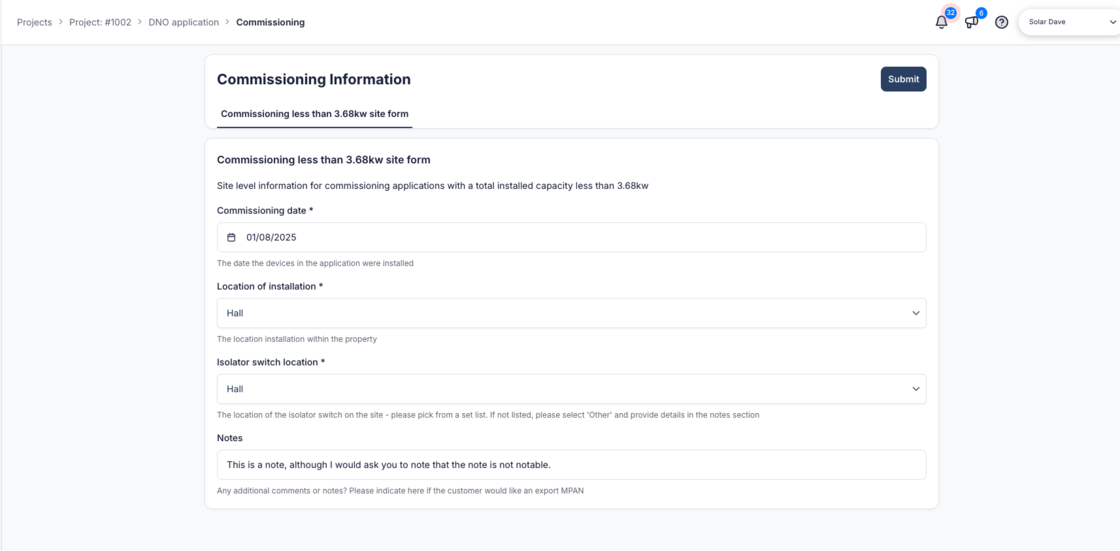
Payaca now handles commissioning applications for G98 and G99 installations. Complete the full DNO compliance workflow from initial application to final energisation approval.
ServiceTitan dominates field service, but it was built for HVAC. Here's an honest comparison of the alternatives for solar installers - including where each one is strong, where it falls short, and how to choose based on your business stage.