HubSpot, Salesforce, Monday.com and Pipedrive are general-purpose tools, built around the deal. Permit tracking, solar design, install workflows and a field app for crews aren't built in, so a solar install business adds them itself, with custom fields, marketplace apps, a custom build or spreadsheets.
Payaca is built for clean energy install businesses, from growing residential teams to enterprise operations. The lead, the proposal, the permit, the install and the invoice sit on one record. In the UK, OVO Solar & Heating runs 16 franchises on one system.
The short answer
A generic CRM is right if closing the deal is the hard part. In clean energy installation the hard part is everything after it.
- Payaca is best for install businesses that have outgrown a CRM which stops at deal-closed and leaves install and permitting to spreadsheets.
- a generic CRM is best for businesses whose operational work genuinely ends when the sale does, or who already run a separate delivery system.
- Payaca publishes its pricing: Growth, the standard plan for established install businesses, is $1,724/month. Current plans and eligibility are on the pricing page. Most generic CRMs publish per-user tiers, so cost scales with headcount rather than capability.
Looking at this yourself?
We'll show you your own jobs in Payaca, side by side with how you run them in a generic CRM today. Request a demo
See it in Payaca
The real product, on our demo accounts.
Compliance & documentation
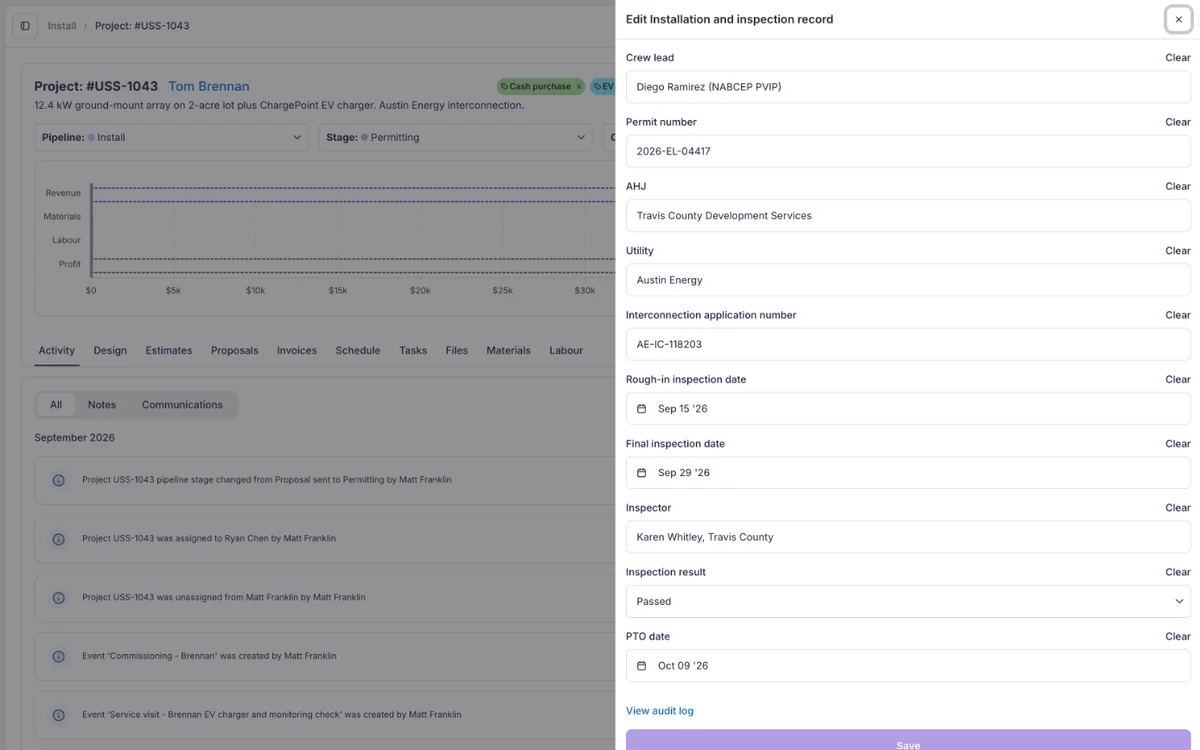
Track permits, PTO and incentive records on every job. More on Compliance & documentation
Operations & scheduling
Schedule your field team on a map and track every job. More on Operations & scheduling
The whole job in 100 seconds
Popular CRMs and where they stop
- HubSpot: A marketing and sales CRM for any industry. No crew scheduling, permit tracking or solar design built in.
- Salesforce: An enterprise CRM you customize to fit. Solar workflows need a custom build, and Field Service is licensed separately.
- Monday.com: A work management tool built on boards you set up; its website also lists a CRM with quotes and invoices. Solar workflows are partner templates or boards you build yourself.
- Pipedrive: A sales CRM for pipeline management, with a Projects add-on for delivery tasks. Invoicing runs through a connected app, and field work isn't the focus.
What generic CRMs are missing
Solar install businesses have requirements that general-purpose software wasn't designed for. On a generic CRM, each of these is something you add yourself.
- Permit tracking. Generic CRMs have no permit, inspection or PTO tracking out of the box. You build it with custom fields or keep it in a spreadsheet.
- Design tool integration. No solar design in the system. Connecting OpenSolar means a third-party connector, or re-entering system details into quotes by hand.
- Installation workflows. CRMs are built around deals. Project add-ons track tasks, but survey, install, inspection and handover stages are yours to design and maintain.
- Field team mobile app. CRM mobile apps are built for sales reps and board updates. Job forms, site photos and timesheets for crews usually mean a separate field service product.
- Solar proposals. Generic quote tools price a list of products. They don't build multi-option solar, battery and EV charger proposals from a design.
- Incentive tracking. No built-in place to track incentives and utility rebates against each job, so they end up in custom fields or spreadsheets.
Switching from a generic CRM
Most CRMs export contacts, companies and deals as CSV files. We import them into Payaca through our API and import tooling: customers with their contacts and addresses, deals as projects at the right pipeline stage, and the tags, custom fields and notes that go with them. Files you still need can be attached to the project.
Guided onboarding is available on Growth and above: we map your workflows, migrate your data and train your team, for a one-off $2,000. The pricing page has the details.
Some businesses keep their old CRM for one job, often marketing, and pass new leads into Payaca through the open API, webhooks or Zapier.
Which is right for you?
Choose Payaca if
- You need permits, inspections, PTO and interconnection tracked on every project
- You want solar design in the system with Glow (limited release), or imported from OpenSolar
- You want multi-option solar proposals with equipment specs
- You want survey, install, inspection and handover as one workflow
- You want to connect your other tools through the REST API, webhooks, Zapier and the MCP server
Consider a generic CRM if
- Closing the deal is the hard part and your work ends when the sale does
- You already run install and permitting in a separate delivery system
Questions
Can I customize HubSpot or Salesforce for solar installations?
Yes, but it takes time and money. You'd need custom objects, workflows and third-party apps for permits, crews and design tools, plus someone to maintain them. For many solar companies the cost of building it outweighs the value.
Why not use a CRM for sales and separate tools for operations?
You can, but you'll face data silos, manual re-entry, and reconciliation issues. When sales data doesn't flow into operations, you lose visibility and efficiency. Purpose-built software keeps everything connected, from lead to installation to handover.
What about Monday.com for project management?
Monday.com is a work management tool: boards you set up for any kind of project. Its website also lists quotes and invoices in monday CRM. Permit tracking and solar install workflows are still boards you build yourself or buy as a partner template. See our detailed Monday.com comparison.
Is Pipedrive enough for a small solar company?
Pipedrive is a sales CRM, and it handles pipelines well. Its Projects add-on tracks delivery tasks once a deal is won. Invoicing runs through a connected invoicing app, and crew scheduling, field work and permits aren't what it's built for. As you grow, managing disconnected tools gets harder.
How does Payaca compare to building a custom Salesforce solution?
Payaca is ready to use with solar features built in. A custom Salesforce build for a solar business means licenses plus development and ongoing maintenance. Payaca gives you those features out of the box, with support from people who understand the industry.
What if we already use HubSpot for marketing?
You can keep HubSpot for marketing while using Payaca for operations, passing leads across through the open API, webhooks or Zapier. Payaca handles everything from there: proposals, jobs, permits, invoicing.
Competitor details are based on their public information as of October 29, 2026. Spotted something out of date? Tell us.