HubSpot, Salesforce, Monday and Pipedrive are built for marketing, sales pipelines and general work management. None of them was built for the job after the sale. They don't understand DNO applications, MCS compliance or multi-stage installation workflows, so a clean tech business ends up building those by hand or adding tools around the CRM.
Payaca is built for that part: the survey, the design, the DNO application, the install, commissioning and handover, on the same record as the lead and the proposal. Here's what a generic CRM leaves out, and what you get instead.
The short answer
A generic CRM is the right tool if closing the deal is the hard part. For clean tech installation the hard part is everything after it, which is what Payaca covers.
- Payaca is best for install businesses that have outgrown a CRM which stops at deal-closed and leaves the install, compliance and commissioning to spreadsheets.
- a generic CRM is best for businesses whose operational work genuinely ends when the sale does, or who already run a separate system for delivery.
- Payaca publishes its pricing: Growth, the standard plan for established install businesses, is £1,199/month. Current plans and eligibility are on the pricing page. Most generic CRMs publish per-user tiers, so the cost scales with headcount rather than with what the tool does.
Looking at this yourself?
We'll show you your own jobs in Payaca, side by side with how you run them in a generic CRM today. Book a demo
See it in Payaca
The real product, on our demo accounts.
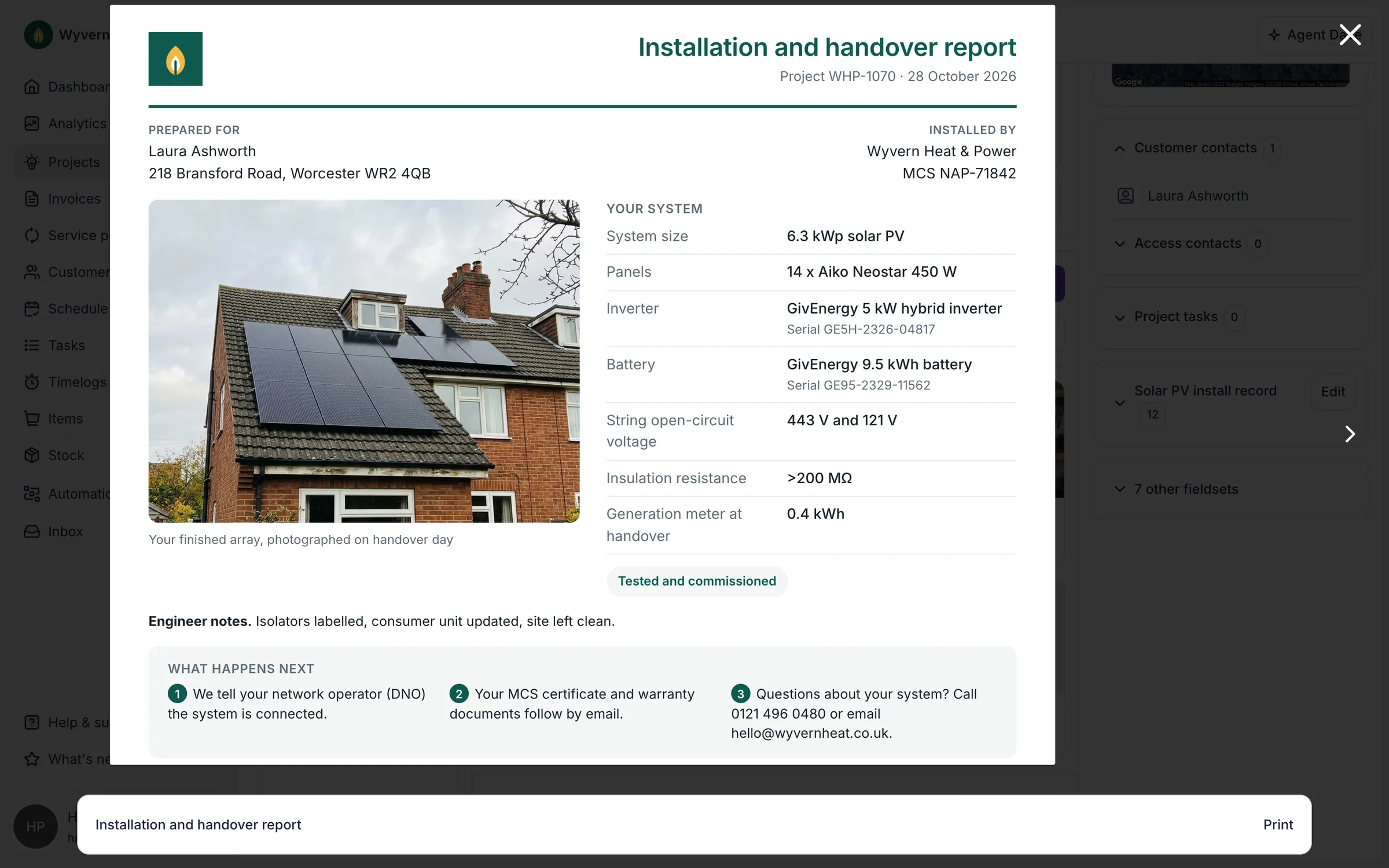
Compliance & documentation
Generate MCS documents and keep every certificate on the job. More on Compliance & documentation
Operations & scheduling
Schedule your field team on a map and track every job. More on Operations & scheduling
The whole job in 100 seconds
Popular CRMs and where they stop
- HubSpot. Marketing and sales CRM with a free tier. No installation workflow, compliance or built-in field app. Payaca vs HubSpot
- Salesforce. Enterprise CRM you customise to fit. Installation workflows need custom development, and Field Service is a separate licence. Payaca vs Salesforce
- Monday.com. Work management platform with visual workflows. Boards you build yourself, with no clean tech compliance. Payaca vs Monday.com
- Pipedrive. Sales-focused CRM for pipeline management. Sales pipeline first, with no field app or compliance. Payaca vs Pipedrive
What generic CRMs are missing
Clean tech install businesses have requirements that generic software wasn't designed for.
- DNO applications. Generic CRMs don't connect to ENA Connect for G98/G99 submissions. You'll need separate tools and manual data entry.
- MCS compliance. No built-in MCS certificate generation. You'll create documents manually or use additional tools, risking compliance gaps.
- Design tool integration. No design in the system and no connection to EasyPV, Heatpunk or OpenSolar. You'll manually re-enter system specifications into quotes.
- Installation workflows. CRMs are built around deals, not multi-stage installation projects. You'll need workarounds for the survey, install, commissioning and handover stages.
- Field team mobile app. General CRM apps are built for sales reps, not engineers on site, and offline job forms usually mean another app. Field data capture becomes a separate problem.
- Clean tech quoting. Generic quoting isn't built for multi-option system configurations, equipment specifications or grants such as the Boiler Upgrade Scheme.
What purpose-built software gives you
Payaca is built specifically for clean tech install businesses. Instead of adapting generic software to your needs, you get tools designed for how you actually work.
- DNO applications. Submit G98/G99 via ENA Connect directly from jobs.
- MCS compliance. Generate MCS certificates and documentation from the job data.
- Design built in. Design in Payaca with Glow (limited release), or import from EasyPV, Heatpunk and OpenSolar.
- Installation workflows. Survey to install to commission to handover, with stage automations and rules that stop a job moving on until the work is done.
- Proposals and payments. Multi-option proposals the customer signs and pays the deposit on in one flow, then invoices with two-way Xero and QuickBooks sync.
- AI built in. Agent Dave answers from your account data, drafts proposals and templates, and builds automations you check before they go live.
- Open API. Connect your other tools with open API access, Zapier and our MCP server.
Payaca serves install businesses from growing teams through to OVO Solar & Heating, which runs 16 franchises on one system. View pricing
Switching from a generic CRM
Export your contacts, companies and open deals from HubSpot, Salesforce or Pipedrive, or your boards from Monday, as CSV. We load them through our import tooling as customers, contacts and projects, each placed at the right stage of your pipeline, with notes carried across.
You don't have to drop the old tool entirely. Some businesses keep HubSpot or another CRM for marketing and connect it to Payaca through our open API or Zapier, so the campaigns stay where they are and the job runs in Payaca.
Growth and above include guided onboarding: we map your workflow, migrate your data and train your team, for a one-off £1,500.
Questions
Can I customise HubSpot or Salesforce for solar installations?
Yes, but it's expensive and time-consuming. You'd need custom objects, workflows, and potentially third-party apps for each compliance requirement. Most install businesses find the cost of customisation exceeds the value, and you'll still lack a direct DNO integration and design tool connections.
Why not use a CRM for sales and separate tools for operations?
You can, but you'll face data silos, manual re-entry, and reconciliation issues. When sales data doesn't flow into operations, you lose visibility and efficiency. Purpose-built software keeps everything connected, from lead to installation to handover.
What about Monday.com for project management?
Monday.com is a general work management tool, and monday CRM's website also lists quotes and invoices. What it doesn't have is anything for clean tech: no DNO applications, no MCS paperwork and no design tool connections, so you'd build the installation workflow and still need compliance tools separately. See our detailed Monday.com comparison.
Is Pipedrive enough for a small solar company?
Pipedrive is a sales pipeline tool. Its website lists a Projects add-on and Smart Docs for handover and signed quotes. Once you win a job you still need separate tools for engineer scheduling, the field team, invoicing and compliance. As you grow, managing several disconnected tools becomes hard to sustain.
How does Payaca compare to building a custom Salesforce solution?
Payaca is ready to use with clean tech features built in, at a fraction of the cost. A custom Salesforce build for an install business means paying for development and ongoing admin on top of per-user licences. Payaca gives you those features out of the box with support from people who understand the industry.
What if we already use HubSpot for marketing?
Keep it. Run HubSpot for marketing and Payaca for sales, operations and compliance, connected through Payaca's open API or Zapier, so qualified leads arrive in Payaca as new enquiries.
Competitor details are based on their public information as of 29 October 2026. Spotted something out of date? Tell us.