Blog
Why we built Glow and Flow
Why Payaca built solar design and heat pump estimates into the system installers run the job in, and why we're still open to the tools you use.
Breaks down how solar panels are recycled and some of the challenges involved in the recycling process. This article covers specific examples from the UK as well as predictions about where the industry is headed.
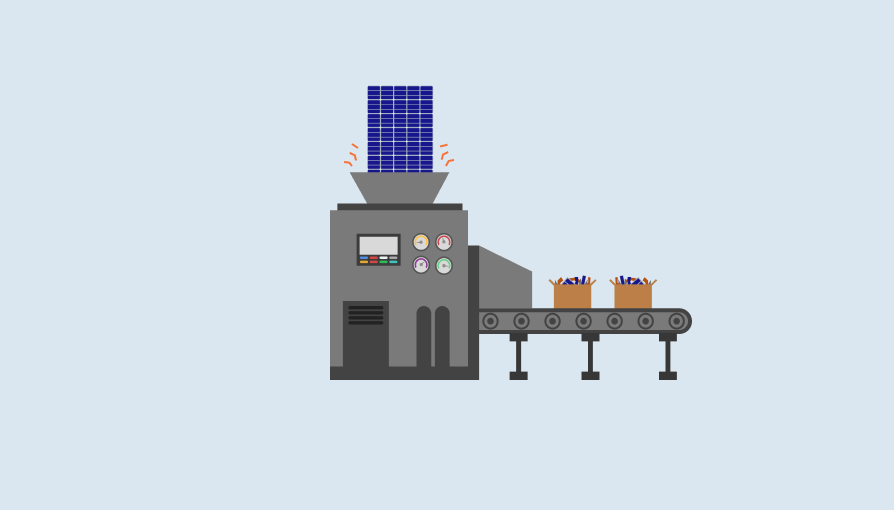
Solar panels feature complex construction with multiple fused components, making them notoriously difficult to disassemble. However, they are recyclable through processes designed to separate glass, plastic, and metals into component parts.
The recycling industry remains nascent, with different companies developing unique separation processes. However, all facilities broadly follow similar steps using automated machinery.
Solar panels employ a sandwich structure: silicon crystal cells in the middle, covered by glass and plastic front layers with plastic backing, held by an aluminum frame. Most panels use silver conductors and copper wiring.
The recycling process reverses panel construction:
Film-based and silicon panels require slightly different approaches - silicon panels use acid separation while film panels use rotating screws.
The solar recycling market is relatively young since early panels installed 25 years ago are only now reaching end-of-life. This created a lag between production and recycling infrastructure, though innovation is accelerating.
Emerging technologies include microwave-based material separation developed by Australian researchers, potentially reducing costs and improving efficiency as demand increases.
The Waste Electrical and Electronic Equipment (WEEE) Directive regulates solar panel disposal in the UK, prohibiting landfill disposal due to environmental hazards and valuable material content. Solar recycling is legally required.
Both silicon and film-based panels are recycled nationwide through disposal companies in London, Birmingham, Hereford, Sheffield, and Leeds, offering national collection services.
Manufacturers and importers bear legal responsibility for end-of-life disposal. Many installers provide take-back services.
Major UK recycling services include: Recycle Solar, Solar Recycling Solutions (SRS), Collect and Recycle, PV Cycle UK, Waste Experts, Start Solar, Trust Solar Wholesale Ltd, Waxman Energy Ltd, and Wind & Sun Ltd.
Panel lifespan depends on acceptable efficiency thresholds. Standard metrics quote 25-30 year life expectancies.
Some evidence suggests efficiency declines follow a falling curve - rapid initial decline (1.5-1.8%) slowing over time, potentially enabling 25% operation after a century.
Consumers face no recycling costs. Manufacturers are primarily responsible and must cover removal and recycling expenses. When installers replace old panels, they should offer take-back schemes covering removal and transportation to certified facilities.
Recycling costs between $15-$45 per module, while landfill disposal costs only $1.38-$5.00 per module - creating limited economic incentive for recycling. Recovered materials yield limited value, with glass cullet worth approximately $3 per panel.
However, Paris-based ROSI developed processes recovering high-value materials (silicon, silver, copper) at lower cost and impact, producing purer silicon than metallurgical-grade. The value of solar panel materials is predicted at $2 billion by 2050.
Solar energy generates 12 times less CO2 than natural gas and 20 times less than coal. Every recycled solar panel saves approximately 97 pounds (44kg) of CO2, increasing to 1.5 tonnes if reused.
Recycling aluminum consumes 95% less energy than producing new aluminum.
Beyond recycling, older panels can be reused and refurbished. While less efficient than new panels, second-hand PV offers cheaper alternatives.
Businesses frequently replace functioning panels before end-of-life due to efficiency improvements. Refurbished panels cost $0.05-$0.15 per watt compared to new panel production at $0.50 per watt.
Currently, 90% of solar panels still end up in landfill, with just 10% getting recycled. As the solar industry expands globally, efficient, cost-effective recycling becomes essential.
The substantial value in panel raw materials provides future economic incentive once extraction processes improve. For prospective panel buyers, the industry trends positively - recycling infrastructure will likely be established before panel end-of-life occurs.
See how Payaca helps clean tech installers save time and grow their business.
Book a demoWant more from Payaca in your Google results?
Why Payaca built solar design and heat pump estimates into the system installers run the job in, and why we're still open to the tools you use.

HubSpot wins solar, heat pump and EV installers on the way up - and loses them as soon as the install team starts using it. Five patterns we keep seeing in migration calls.

Salesforce, HubSpot, and ServiceTitan weren't built for clean tech. Here's what happens when installers switch to a purpose-built platform.