Blog
Why we built Glow and Flow
Why Payaca built solar design and heat pump estimates into the system installers run the job in, and why we're still open to the tools you use.
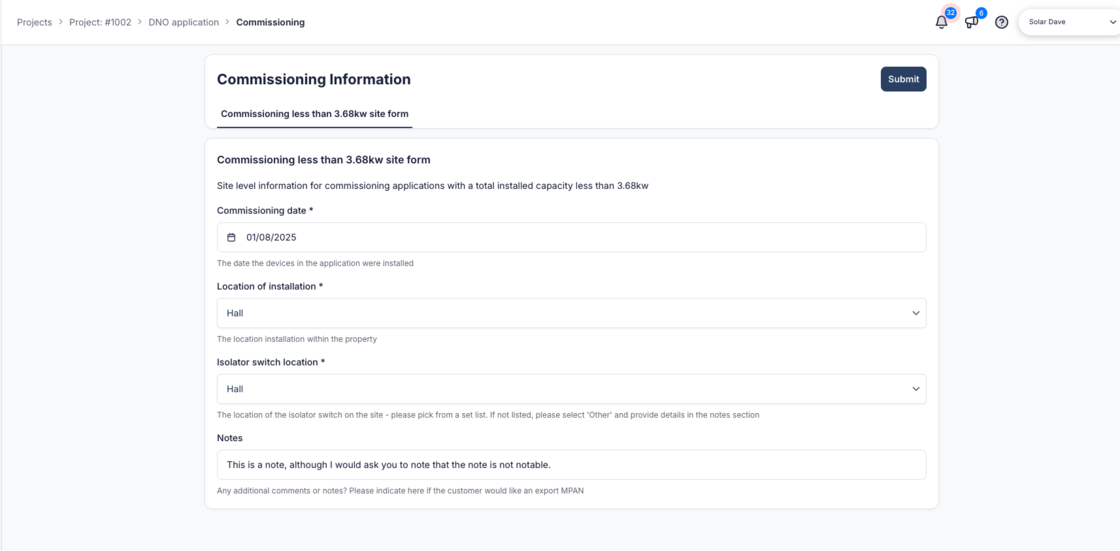
Payaca now handles commissioning applications for G98 and G99 installations. Complete the full DNO compliance workflow from initial application to final energisation approval.
We've been handling G98 and G99 applications in Payaca for a while now, and the feedback from installers was consistent: the initial application is sorted, but then we're back to manual processes for the commissioning stage. It's the same DNO, the same project, the same data - why are we filling out forms again?
So we built it. Payaca now handles commissioning applications for both G98 and G99 installations, completing the full DNO compliance workflow from initial application through to energisation approval.
Commissioning is the final step in getting a solar or battery system connected to the grid. After installation, you need to formally notify the DNO that the system meets the approved specifications and is ready for safe grid connection.
For most installers, this means gathering technical documentation, electrical certificates, test results, and equipment specs - then submitting them manually to the DNO. It's time-consuming, error-prone, and it delays the point where the customer's system goes live and you can close out the project.
That delay hits cash flow directly. If your final payment is tied to energisation, every day the commissioning application sits in a queue is a day you're not getting paid for completed work.
The system handles both G98 notifications (smaller systems up to 16A per phase) and G99 applications (larger installations). It automatically determines which commissioning process applies based on your original application.
The biggest time saver is that Payaca already has the technical details from your initial G98/G99 application. Equipment specs, system configuration, site details - all of it carries through to the commissioning stage. You're not re-entering the same information into a different form.
Commissioning requires a stack of documentation: Electrical Installation Certificates (EIC), Minor Electrical Installation Works Certificates (MEIWC), Periodic Inspection Reports (PIR), equipment commissioning certificates from inverter and battery manufacturers, and protection system verification for anti-islanding and loss of mains testing.
Payaca tracks all of these in one place. Your engineers can upload certificates from the mobile app on site, and the office can see immediately what's been completed and what's outstanding.
Before you submit, Payaca checks the application against DNO requirements - protection relay settings, electrical certificates, equipment specs, safety documentation, metering configuration. This catches errors before they cause rejections and delays.
Commissioning submissions go through ENA Connect Direct to all six UK Distribution Network Operators, the same integration we use for initial applications. Each DNO has slightly different commissioning requirements and timelines, which the system handles automatically.
You can see exactly where each commissioning application sits in the approval process. Automated notifications flag DNO acknowledgment, inspection scheduling (for G99 installations that require witness testing), and final energisation permission.
Field engineers can collect all required commissioning information directly from site using the Payaca mobile app. Final installation photos, meter readings, test results, and commissioning certificates captured during the final site visit sync automatically to the office system.
This means the office team can submit the commissioning application as soon as the engineer leaves site, rather than waiting for photos and test results to be emailed across or brought back on paper.
Payaca also handles heat pump and EV charger connection applications through the same ENA Connect Direct integration. The aim is that every type of DNO application an installer needs to make can be handled from within Payaca, from initial application through to final commissioning.
If you're not sure whether a job needs a G98 notification or a G99 application, the checker works it out from the postcode and system size. If you're already using our G98/G99 application integration, you'll see commissioning options appear automatically as your installations move towards completion. If you're not using the DNO integration yet and want to, get in touch and we'll set you up.
See how Payaca helps clean tech installers save time and grow their business.
Book a demoWant more from Payaca in your Google results?
Why Payaca built solar design and heat pump estimates into the system installers run the job in, and why we're still open to the tools you use.
Payaca automations now fire the moment a document is signed, and task templates carry a default assignee and deadline. How UK installers chain signatures, stage moves and pre-assigned tasks into one workflow.

Payaca automations now fire on DNO application status changes and on every change proposal event, not just acceptance. How UK installers wire up the two mid-job waits that stall installs: grid applications and scope changes.